What "Functional Cosmetic" Means on Korean Skincare (MFDS, Explained)
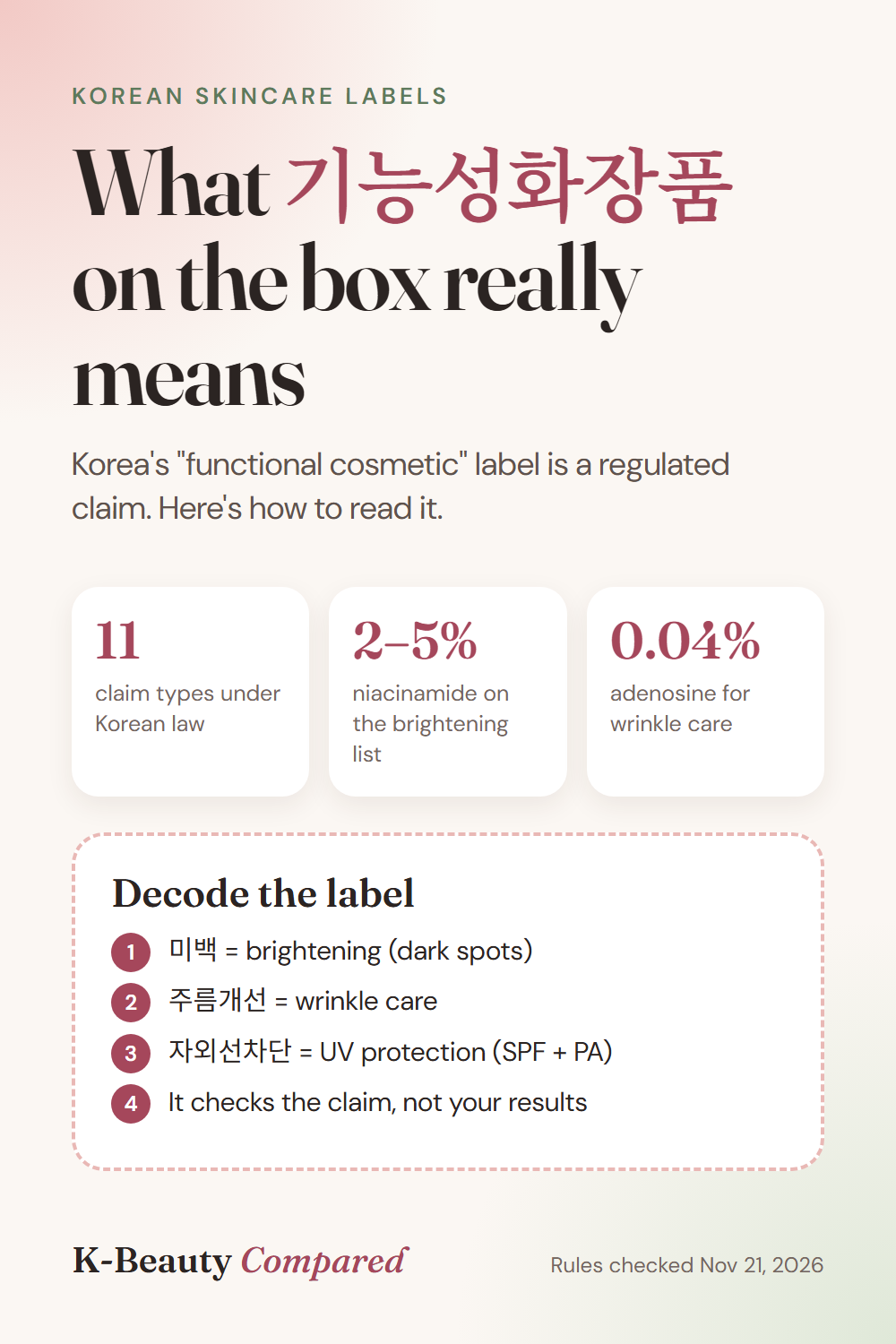
That 기능성화장품 line on a Korean box is a regulated claim. Here are the 11 functional categories, the approved ingredients and amounts, and how to check a product.

In this guide
Turn a Korean skincare box around and you’ll sometimes find a short line in Korean: 기능성화장품, pronounced gi-neung-seong hwa-jang-pum. It translates as “functional cosmetic,” and it’s one of the most useful things on the label, because it’s regulated. Here’s what it means, in plain English.
What “functional cosmetic” actually means
In Korea, a regular cosmetic can only claim the basics: cleansing, moisturizing, making skin look healthy. If a product wants to claim something stronger, like fading dark spots or improving wrinkles, it has to become a functional cosmetic first.
That means the company either sends the product to the Ministry of Food and Drug Safety (MFDS) for review, or files a report showing it matches an ingredient and amount MFDS has already approved for that claim. Korean law then requires the words “기능성화장품” (or an official MFDS symbol) on the package, along with the approved claim and directions.
In short: a Korean brand can't just print "anti-wrinkle" on a regular cream. The functional label is what earns that claim.
The 11 functional categories
Korea’s cosmetics rules list 11 kinds of functional cosmetics. In plain English:
Most common
Brightening: prevents dark spots
미백
Most common
Brightening: fades existing dark spots
미백
Most common
Wrinkle care
주름개선
Most common
UV protection
자외선차단
Sun
Helps you tan evenly
Rare in skincare
Hair
Hair color, bleaching and color removal
Not temporary color
Body
Hair removal
Chemical, not wax
Hair
Eases hair-loss symptoms
"Not a medicine" label
Skin
Acne-prone skin (cleansers only)
"Not a medicine" label
Skin
Itch relief by restoring the skin barrier
"Not a medicine" label
Body
Fades red stretch marks
"Not a medicine" label
Two details are easy to miss:
- The acne category only covers cleansers. A Korean serum or cream can’t carry the acne functional claim.
- The last four categories must say they’re not medicine. Korean rules require the line “질병의 예방 및 치료를 위한 의약품이 아님” (not a medicine for preventing or treating disease), printed right under the functional label.
The ingredient list for brightening and wrinkle care
The fastest route to a functional label is to use an ingredient MFDS has already approved, at the approved amount, in a standard format like a lotion, serum, cream or sheet mask. These are the ingredients on that standard list.
Brightening (미백)
| Ingredient (as on INCI lists) | Approved amount |
|---|---|
| Niacinamide | 2–5% |
| Arbutin | 2–5% |
| Ethyl ascorbyl ether (vitamin C derivative) | 1–2% |
| Ascorbyl glucoside (vitamin C derivative) | 2% |
| Magnesium ascorbyl phosphate (vitamin C derivative) | 3% |
| Ascorbyl tetraisopalmitate (vitamin C derivative) | 2% |
| Paper mulberry (Broussonetia) extract | 2% |
| Oil-soluble licorice extract | 0.05% |
| Alpha-bisabolol | 0.5% |
Wrinkle care (주름개선)
| Ingredient | Approved amount |
|---|---|
| Retinol | 2,500 IU/g |
| Retinyl palmitate | 10,000 IU/g |
| Adenosine | 0.04% |
| Polyethoxylated retinamide | 0.05–0.2% |
Adenosine is the one you’ll find everywhere. At 0.04% it’s an easy add to creams, serums and even sheet masks, which is why so many Korean products carry a wrinkle-care label.
Shop smarter: a product can also qualify through a full MFDS review with other ingredients or amounts, so this list isn't the only way in. But if a brightening serum says "niacinamide" and has no functional label, don't assume it has 2–5%.
Korean sunscreen: SPF plus PA
Sunscreen is its own functional category, and its label has two parts:
- SPF measures protection against UVB, the rays mainly behind sunburn, the same idea as in the US.
- PA, from PA+ to PA++++, rates protection against UVA, the rays linked to tanning and skin aging. US sunscreens use “broad spectrum” instead of a graded scale.
Korea’s approved UV-filter list is longer than the US one. A good example is bemotrizinol, which Korean labels list as 비스-에칠헥실옥시페놀메톡시페닐트리아진. Korea allows it at up to 10%. The FDA only added it to the US sunscreen rules in June 2026, at up to 6%. It’s a big reason US shoppers seek out Korean sunscreens, and why a US version of a Korean sunscreen can have a different formula.
What the label does and doesn’t tell you
It does tell you
The claim was reviewed or reported to MFDS
Regulated claim
It does tell you
The active is in an approved range
On the standard route
It doesn't tell you
That it will work for your skin
Results vary
It doesn't tell you
That it's stronger than an unlabeled product
Not a ranking
Think of it as a check on the claim, not a promise about results. Two adenosine creams can both carry the label and feel completely different on your face.
There’s also a US twist. In the US, products that claim to change how skin works can be treated as drugs, so brands often soften their wording on US packaging. The same cream might say “wrinkle care” on its Korean box and simply “firming” or “smoothing” on its US listing.
How to check a product from the US
Your functional-label checklist
- Look for 기능성화장품 on the box. It's usually near the ingredient list. Many US listings show the Korean back label in their photos.
- On a Korean retailer page, open the product information notice (상품정보제공고시). It includes a line on MFDS review for functional cosmetics.
- Match the claim to the category. 미백 = brightening, 주름개선 = wrinkle care, 자외선차단 = UV protection.
- For sunscreen, check both numbers: SPF for burning, PA for UVA.
- Read the US listing's ingredients too. A version made for the US market can differ from the Korean one.
How we checked
We read the current Korean Cosmetics Act (Article 10, labeling) and its Enforcement Rule (Article 2 for the 11 categories, Article 19 for package labeling), plus MFDS’s standard ingredient list for functional cosmetics, on November 21, 2026. Korean rules are updated from time to time, so check MFDS or Korea’s National Law Information Center for the latest text. This guide explains labels; it isn’t medical advice, and for skin conditions see a dermatologist. More in How we research.
FAQ
Does 'functional cosmetic' mean the product is medicine?
No. Functional cosmetics are still cosmetics under Korean law. For four of the categories (hair-loss symptoms, acne-prone skin cleansers, itch relief through barrier repair, and stretch marks), the box must even state that the product is not a medicine for preventing or treating disease.
Is 'whitening' (미백) about changing skin tone?
In Korean regulation, 미백 means helping prevent or fade dark spots such as melasma-type pigmentation and freckles. English-language listings usually translate it as brightening.
If a serum contains niacinamide, is it a functional cosmetic?
Not automatically. A product qualifies only if the company reviewed or reported it to MFDS, and on the standard route niacinamide must be in a 2–5% range. Look for the 기능성화장품 wording on the box or in the listing.
How can I check from the US?
On a Korean retailer's product page, look in the product information notice (상품정보제공고시) for the MFDS review line, or look for 기능성화장품 on the package photo. Some US listings show the Korean box, too.
We read Korean rankings and reviews and summarize the patterns in our own words; we don't copy or store reviews. Rankings and prices change often, so check the retailer before you buy. Nothing here is medical advice.